Prague looks compact on a map, and it is — but the districts inside that compact center behave very differently. The same trip can cost 30-50% more depending on where you book, and the street that charms you at noon can keep you awake at 2 a.m. Choosing the wrong base is one of the most common ways travelers end up disappointed with their Prague hotels.
This guide walks through the city district by district, so you can match your base to your trip. We cover Old Town and Josefov for sightseeing at your doorstep, Malá Strana and the Castle District for a quieter, romantic stay, New Town for central convenience without the top rates, Vinohrady and Žižkov for local life east of the center, and Smíchov and Karlín as value bases. A final section pulls it together with practical tips on when to book and how to compare districts before you commit.
Old Town and Josefov: Sights at the Doorstep
Staying in Old Town or Josefov puts you inside the postcard. From a hotel here, you can walk to Old Town Square, the Astronomical Clock and the Jewish Quarter in minutes, often in less time than it takes to finish your morning coffee. When your sightseeing list is long and your stay is short, that proximity changes how much you can actually see.
What the location costs you
The trade-off is price. This is the most expensive part of the city to book, with rates typically running 30-50% above what you would pay in outer districts. You are paying for footsteps, not square meters, and rooms here tend to be smaller for the money.
Who it suits — and who it doesn’t
Old Town works best for short first visits where sightseeing time matters most. If you have two or three nights and want to see the main sights without relying on public transport, the premium is easy to justify. You can pop back to your hotel midday to drop bags or rest, then head out again.
The downside is noise. This is the noisiest area at night, especially around the bar-filled streets that fill up on weekends. Light sleepers should look for rooms facing inner courtyards rather than the street, and ask about this when booking — many older buildings here have thin windows and lively neighbors. If your trip stretches beyond a few days, the constant crowds in every direction can start to feel wearing rather than exciting.
Malá Strana and Castle District: Quiet and Romantic
Cross the river from Old Town and the mood shifts immediately. Malá Strana and the Castle District sit on cobbled lanes below Prague Castle, with a calmer, residential feel that the squares across the water never quite manage. Greenery creeps down the hillside, locals go about their evenings, and the tourist crowds thin out noticeably once you leave the main thoroughfares.
Where you’ll sleep
Accommodation here has a distinct character: boutique and palace-style hotels dominate rather than large chains. Many occupy converted aristocratic residences, so you get vaulted ceilings, period details and garden courtyards instead of standardized business rooms. If atmosphere matters to you more than a gym or a 24-hour lobby, this is the district that delivers it.
What’s within reach
The location is more practical than it first appears. Petřín hill and the Charles Bridge are a short walk away, and from the bridge you are minutes from Old Town on foot. You trade nothing in terms of major sights — you simply approach them from the quiet side of the river.
Evenings are the real difference. Fewer restaurants stay open late here, so the district goes quiet earlier than Old Town does. That is exactly what some travelers want after a full day of walking, and exactly what others find too sleepy. If you like a late dinner followed by bars within stumbling distance, book across the river. If you want romance, cobbles and silence at midnight, Malá Strana is hard to beat.
New Town: Central Convenience Without Old Town Prices
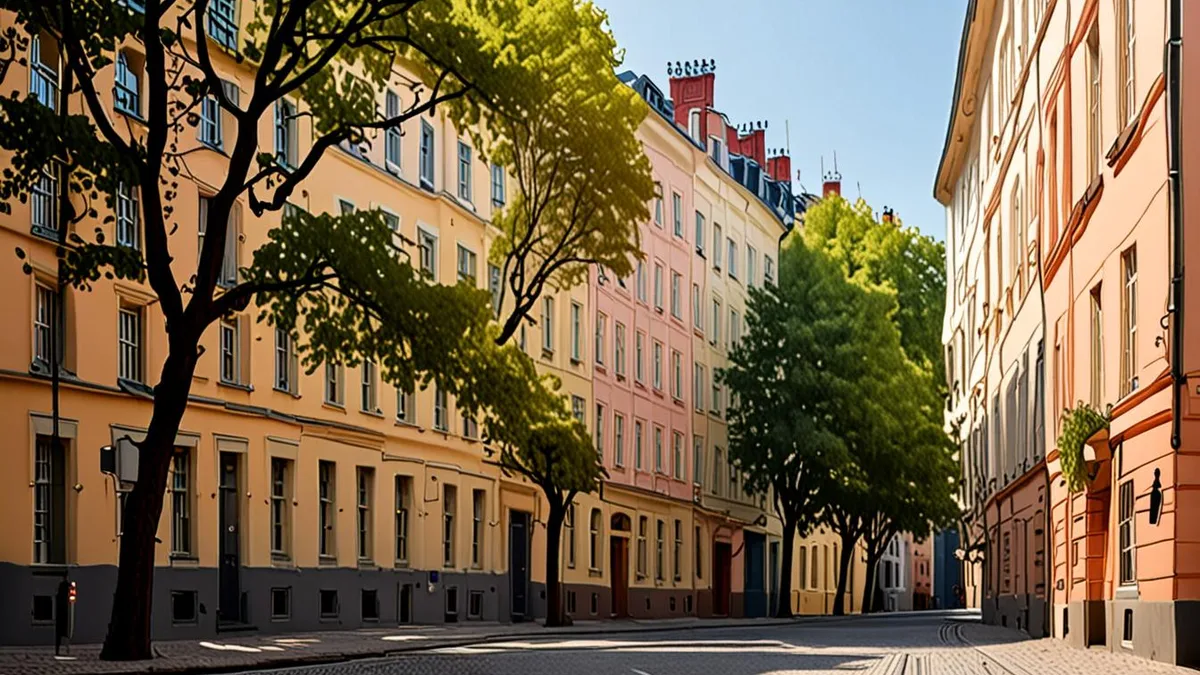
New Town is the pragmatic traveler’s favorite. The Wenceslas Square area sits a 10-15 minute walk south of Old Town Square, close enough that you can reach the historic core on foot in the time it takes to check a map. You get the centrality without paying Old Town’s premium, and the streets feel more like a working city than a museum set.
The hotel scene reflects that. You’ll find more mid-range chains and business hotels here than in the historic core, which means reliable standards, larger rooms and facilities like gyms that older buildings rarely offer. Rates run noticeably below Old Town and Malá Strana for comparable quality.
What else works in your favor
- Metro access from Muzeum and Národní třída: these stops put you on lines that reach most of the city quickly, so you’re not dependent on taxis even for sights beyond walking distance.
- Tram coverage along the main boulevards: trams running through the district connect you to Malá Strana, the riverside and neighborhoods further out without changing lines.
- Everyday practicalities: New Town has more supermarkets, pharmacies and late-opening shops than the historic core, which matters on trips longer than a weekend.
- Room for larger groups: the stock of business-style hotels makes it easier to find family rooms or adjoining options than in converted Old Town buildings.
New Town suits travelers who want centrality but better value — a first visit on a sensible budget, or a city-break base that doesn’t treat location as a luxury surcharge. Check the exact walking time from a specific hotel to Old Town Square before booking, since the district is large and the edges stretch further than the name suggests.
Vinohrady and Žižkov: Local Life East of the Centre
Vinohrady sits just east of the center and feels like a different city altogether. Think leafy residential streets, art nouveau apartment buildings, and corner cafés where locals read the paper over morning coffee. You are still well connected here: a metro or tram ride to Old Town Square typically takes around 15-20 minutes, so sightseeing stays easy without the crowds outside your window.
Hotel rates in Vinohrady are noticeably friendlier than the historic core. In high season, expect mid-range rooms to run roughly 80-120 EUR per night, which can leave plenty of budget for good dinners and day trips. The neighborhood has a solid choice of small hotels and guesthouses, many run by owners who actually live nearby and can point you to their favorite bakery or beer garden.
Žižkov: Cheaper, Grittier, and Full of Bars
Right next door, Žižkov is Vinohrady’s rougher-edged sibling. It is cheaper, a bit scruffier, and popular with travelers who care more about atmosphere than polish. The bar scene here is legendary among locals, with plenty of no-frills pubs and late-night spots that feel a world away from the tourist strips.
This pairing works best for longer stays and for travelers who prefer real neighborhoods over postcard streets. If you like the idea of a local market, a regular café, and a routine rather than a whirlwind, this is your zone. The same logic applies in other cities, by the way: staying where locals live often makes a trip, something I also found when looking into homestays near Munich’s old squares.
Smíchov, Karlín and Riverside Districts: Value Bases
If Vinohrady feels too residential and Old Town too expensive, the riverside districts offer a practical middle ground. Smíchov, on the west bank of the Vltava, connects through the Anděl metro hub and puts you on a direct line into the center. Karlín, northeast of the historic core, has emerged as one of Prague’s most pleasant regenerated quarters, with modern hotels sitting alongside renovated industrial buildings and new cafés.
Rates in both areas run clearly below what you would pay in the historic core, yet you stay on direct metro lines, so getting to the sights never becomes a chore. Like Vinohrady, they fall within the range where most districts sit within 20-30 minutes of Old Town Square by tram or metro, and mid-range rates here typically land in the same 80-120 EUR per night bracket in high season. These districts suit travelers who put price and easy transport at the top of their list, rather than waking up to a castle view. A few practical details worth knowing before you book:
- Anděl is a genuine transport hub: several metro and tram lines meet here, so from Smíchov you can reach most of the city without changing vehicles more than once.
- Karlín’s hotels skew modern: many occupy converted or recently built properties, so expect lifts, air conditioning and business-style rooms rather than cobbled charm.
- Riverside walks come free: both districts put you within reach of the Vltava embankments, an easy evening stroll option that costs nothing.
- Evening food is local, not touristy: dinner options here lean toward neighborhood restaurants and bistros where menus are cheaper than in the center.
The trade-off is atmosphere: you will not step out of your hotel into a fairy-tale street. But if your days are packed with sightseeing anyway, a comfortable, well-connected and affordable base can make a Prague trip both cheaper and more relaxing. As with any central-adjacent district, check the walking distance to your nearest metro or tram stop before booking, since a cheap rate loses its appeal if the commute adds friction every morning.
How to Choose Your District and Book Prague Hotels
Choosing a Prague district comes down to one honest question: how much is stepping out the door into history worth to you? If the answer is “a lot,” pay for it. If it is “some,” you can save real money a few metro stops out. Most districts sit within 20-30 minutes of Old Town Square by tram or metro, so even a cheaper base rarely means sacrificing your whole day to commuting. The trick is deciding what you actually want from the trip before you start comparing hotels, because the right answer differs wildly between a two-night first visit and a week-long stay.
- Match the district to the trip. For a first visit, base yourself in Old Town or New Town so you can walk to the main sights and make the most of limited time. For repeat visits or stays of a week or more, Vinohrady or Smíchov give you more space, better rates and a local rhythm.
- Time your booking. For stays between May and September, book 2-3 months ahead to lock in sensible rates. In winter, 3-4 weeks is often enough, but keep December in mind: the Christmas markets push prices up across all central districts.
- Check the nearest tram or metro stop. A hotel can look central on a map yet sit awkwardly for transport. Look at the walking distance to the closest stop before you book, not just the distance to the sights.
- Compare districts, not just hotels. Pull up high-season rates for two or three districts you are considering and compare like-for-like rooms. The difference between neighboring areas can easily fund an extra dinner or two.
Work through these steps in order and the right base usually becomes obvious. Start with the purpose of your trip, then the timing, then the practical details like transport links, and only then compare individual hotels. Ten minutes of comparison before booking tends to pay off for your entire stay, both in money saved and in time you get back for actually enjoying the city rather than getting to and from your room.
Wrapping Up Your Prague Base
Prague’s districts may look close together on the map, but they differ sharply in price, noise and atmosphere, and the wrong base can shape an entire trip. Old Town and Malá Strana trade higher rates for location and atmosphere, putting you steps from the sights at a premium. New Town balances centrality and cost, while Vinohrady, Žižkov and Smíchov reward value seekers with local character and easier budgets.
Whichever district you choose, timing matters as much as location: booking 2-3 months ahead secures the best rates for the May-September season. Match your base to your travel style, and Prague becomes a city you can enjoy from morning to night without fighting for every kilometer. If this guide helped you plan your stay, leave a comment or share the article with a fellow traveler.